
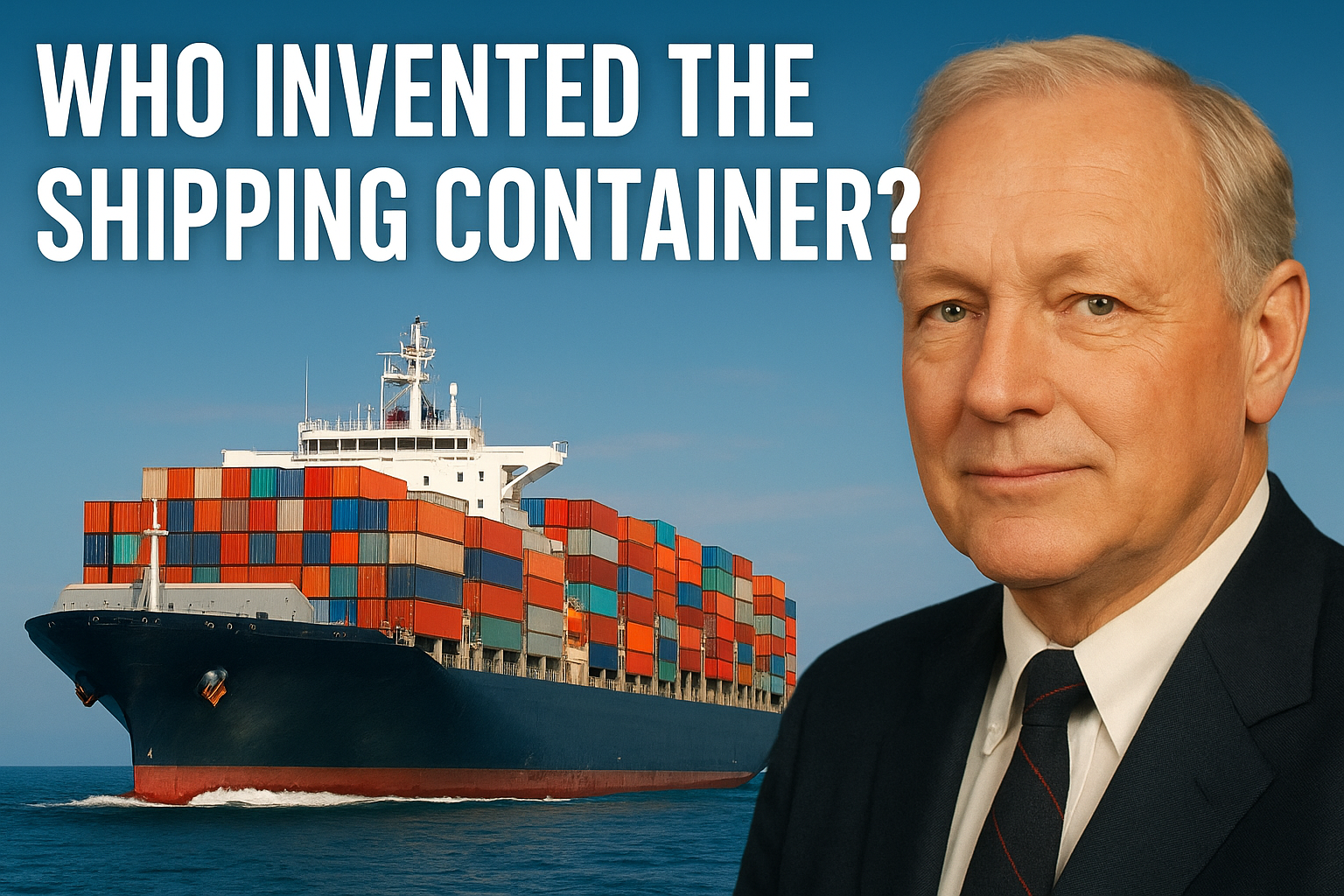
Have you ever wondered who invented the container used in international trade?
Those large steel boxes stacked on ships and trains are the unsung heroes of globalization. They make it possible for your phone from China, your clothes from Bangladesh, and your car parts from Japan to reach you efficiently and affordably.
But behind this simple yet revolutionary invention is one man — Malcolm McLean, the visionary who changed world trade forever.
Before Containers: The Problem with Early Cargo Shipping
Before the 1950s, shipping goods overseas was slow, expensive, and chaotic. Every shipment had to be loaded and unloaded manually — crate by crate, barrel by barrel.
This process, known as break-bulk shipping, required hundreds of dockworkers and could take up to a week for a single ship. Besides being time-consuming, it increased the risk of theft, damage, and high labor costs.
International trade desperately needed a better way — and that’s where Malcolm McLean came in.
Meet Malcolm McLean — The Father of Containerization
Malcolm McLean was not a ship captain or an engineer. He was a truck driver from North Carolina, USA.
One day, while waiting for his truck to be unloaded at a port, he noticed how much time was wasted. He thought:
“What if the entire trailer could be lifted off the truck and placed on the ship — without unloading the cargo?”
That single idea sparked a revolution.
The Birth of Containerization
In 1956, Malcolm McLean bought an old oil tanker named SS Ideal X and modified it to carry metal boxes that could be loaded and unloaded easily.
On April 26, 1956, the SS Ideal X made its historic journey from Newark, New Jersey, to Houston, Texas, carrying 58 containers.
It was a success. The containers arrived safely, costs dropped, and loading times were drastically reduced. The age of containerization had begun.
Why It Changed Everything
McLean’s system used standard-sized steel containers that could move easily between ships, trucks, and trains — without being opened. This concept became known as intermodal transport.
The benefits were enormous:
- Faster loading and unloading — hours instead of days
- Lower shipping costs — up to 90% cheaper
- Easier global trade — manufacturers could produce anywhere and ship everywhere
- Less theft and damage — goods stayed sealed throughout the journey
- Introduction of shipping line business.
In short, Malcolm McLean’s idea made modern globalization possible.
Global Standardization of Containers
After McLean’s success, one challenge remained — different companies were using different container sizes.
To solve this, the International Organization for Standardization (ISO) established standard container sizes in the 1960s — mainly the 20-foot and 40-foot containers still used today.
This global standardization allowed containers to be stacked, stored, and transported seamlessly around the world — from ship to train to truck.
A Revolution That Transformed Global Trade
The impact of containerization was profound:
- It cut shipping costs dramatically.
- It made world trade efficient and interconnected.
- It gave rise to global supply chains, linking producers and consumers across continents.
Ports like Singapore, Rotterdam, and Shanghai became global trade giants — all thanks to McLean’s invention.
Malcolm McLean’s Legacy
Malcolm McLean passed away in 2001, but his legacy remains stronger than ever. He is remembered as the “Father of Containerization” — the man who turned an ordinary trucker’s idea into the backbone of world commerce.
Today, about 90% of global trade moves by sea, and nearly all of it is containerized. Massive container ships now carry more than 20,000 containers per voyage — a scale McLean could only have dreamed of.
His invention didn’t just make shipping faster — it transformed economies, created jobs, and made the modern global marketplace possible.